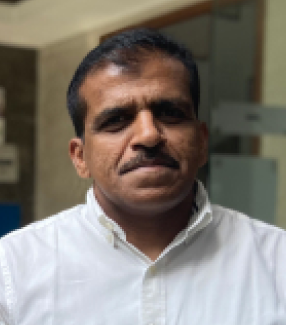


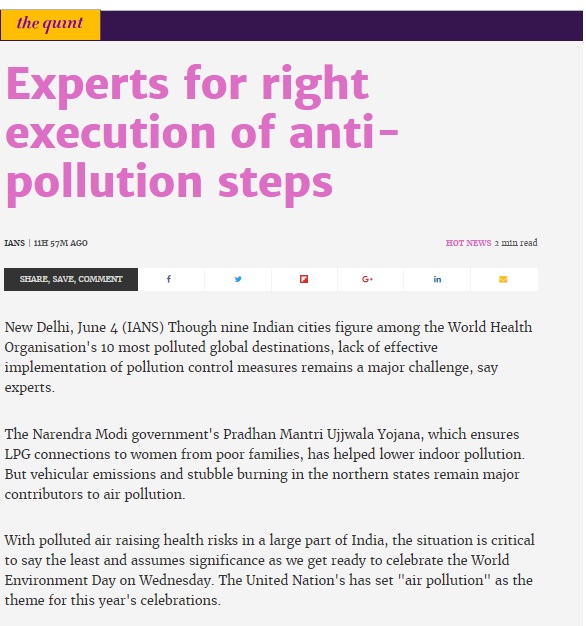
Anand Kumar, Associate Director (Environment and Climate Change) featured in The Quint

Though nine Indian cities figure among the World Health Organisation’s 10 most polluted global destinations, lack of effective implementation of pollution control measures remains a major challenge, say experts.

The Narendra Modi government’s Pradhan Mantri Ujjwala Yojana, which ensures LPG connections to women from poor families, has helped lower indoor pollution. But vehicular emissions and stubble burning in the northern states remain major contributors to air pollution.

With polluted air raising health risks in a large part of India, the situation is critical to say the least and assumes significance as we get ready to celebrate the World Environment Day on Wednesday. The United Nation’s has set “air pollution” as the theme for this year’s celebrations.

“There are policies and programmes to deal with air pollution. But there are issues with their management,” said Anand Kumar, Associate Director (Environment and Climate Change) at IPE Global, a consultancy providing technical assistance and solutions for equitable development and sustainable growth in developing countries.

The government has dealt with vehicular emission through several policies, but stubble burning, which leads to smog and high level of pollutant in the national capital during winters, has not been looked at properly.

Last Diwali, in several parts of Delhi concentration of PM 2.5 exceeded 1,500 µg/m3, way above the “severe” category and could result in respiratory problems to even healthy people, said Kumar.

Environmentalist C.R. Babu stressed the need to raise public awareness. “Technology cannot help much in the fight against air pollution. The natural sinks (to absorb pollutant) have either filled or have been eliminated, while sources of pollution are increasing. How many vacuum cleaners or sprays can be used to remove dust? People’s participation is a must,” he said.

Babu suggested creation of green buffers as one way. “We need multiple patches of vegetation across the urban areas. Only a carpet of greenery can absorb dust and pollutant,” he said.

Nikos Papachristodoulou

Chief Operating Officer

Expertise

Partnership Development • Operations Management • Business Development • Project Management • Advocacy • Leadership Development and Change Management

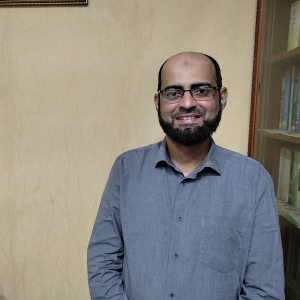
M.K. Padma Kumar is involved in developing strategies and managing operations for the IPE Global Group.

He has over 25 years of experience in the development sector, working in civil society organisations and international development agencies like DANIDA and DFID. As the Head of State Partnerships at the DFID India, he was responsible for developing partnerships, programme design, management and strategic oversight of all programmes implemented in Bihar, Madhya Pradesh and Odisha. He has managed various development programmes. His expertise lies in driving operational, financial and programmatic transformations. Before DFID, he was associated with Danish International Development Agency (DANIDA), Help Age and World Wildlife Fund.

He holds a Master’s degree in Business Management with specialisation in Human Resource Management and Finance. He is extensively trained in Project Cycle Management, Grant Management, Performance Management, Leadership Skills and Change Management.


Abdul Rahim

Chief Knowledge Officer

Expertise

Management Consulting • Finance • Governance • Change Management • Knowledge Management • ICT4D • Communications • Business Strategy

Abdul Rahim is a senior development professional with over 20 years of experience across diverse sectors, including urban, health, rural & social development, and IT & e-governance. He has led several large, multi-year, multi-departmental projects such as the Health Systems Development Initiative (HSDI) for the Government of West Bengal; Odisha Modernising Economy, Governance & Administration (OMEGA) programme for the Government of Odisha, and Growth Resources and Opportunities for Wealth Creation (GROW) with the Government of Bihar.

He played a key role as the Quality Monitoring and Evaluation Expert in the DFID-supported Knowledge Partnership Programme (KPP), Knowledge Management (KM) and M&E Specialist in USAID-supported SAMRIDH and SAMVEG Projects. He has served as the Cross-Learning Platform Expert for the BMGF-supported WeCan programme. He has been an advisor to several government agencies throughout India and internationally across Bangladesh, Afghanistan and Jordan.

He holds a Post Graduate Diploma in Business Management from XLRI Jamshedpur (India). He is an accredited Management Teacher from AIMA. He’s a a certified Trainer, NLP Practitioner and a member of Toastmasters International & Junior Chamber International.

LIFE AT IPE

Learning &
Development (L&D)

We inspire people to be better.

Our intuitive and personalised programmes provide clear path for growth, leadership development, and help people sharpen their skills.

0 %
People trained in last 3 years
0 %
Participation in L&D Initiatives in 2021

Your journey starts from Day One….

Structured Onboarding

Helps align expectations and lays the foundation for your success

New Hire Training

Makes you familiar with the organisation; helps you settle down in a new work environment

Customized L&D Platform

Helps upskill at your own pace through continuous learning and training programmes

Linkage with
Performance Management

Aligns resources and training needs based on your skill set

Learning is not always a formal process. We also align our organisation values to a culture of learning