



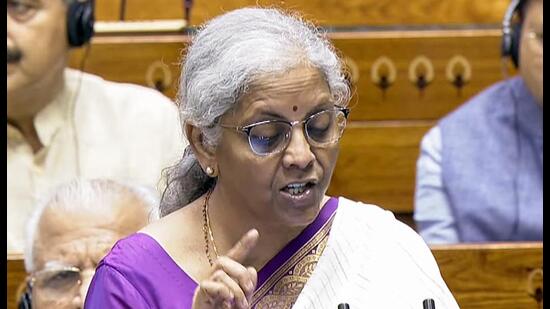

Union finance minister Nirmala Sitharaman on Tuesday announced a diversified energy plan focussed on small, modular nuclear reactors, rooftop solar plants, and the development of indigenous technology for Advanced Ultra Super Critical (AUSC) thermal power plants with much higher energy efficiency.
In her Budget speech, Sitharaman said nuclear energy is expected to form a significant part of the mix for Viksit Bharat or developed India. She added the government will partner with the private sector to set up Bharat Small Reactors, research, and development (R&D) of Bharat Small Modular Reactor, newer technologies for nuclear energy. “The R&D funding announced in the interim Budget will be made available for this sector.”
Sitharaman said PM Surya Ghar Muft Bijli Yojana has been launched to install rooftop solar plants to enable 10 million households to get free electricity up to 300 units monthly. She added the scheme has generated a remarkable response with over 12.8 million registrations and 1.4 million applications. “…we will further encourage it.”
Sitharaman said the development of indigenous technology for AUSC thermal power plants with much higher efficiency has been completed. “A joint venture between NTPC [National Thermal Power Corporation] and BHEL [Bharat Heavy Electricals Ltd] will set up a full-scale 800 MW commercial plant using AUSC technology,” she said. “The government will provide the required fiscal support.”
She said a roadmap for moving the “hard to abate” industries from “energy efficiency” targets to “emission targets” will be formulated.
Sitharaman announced financial assistance for Uttarakhand, Sikkim, Assam, and Himachal Pradesh, which have been affected by climate extremes, flash floods, and cloudbursts. “Assam grapples with floods every year by the Brahmaputra River and its tributaries, originating outside India. We will provide assistance to Assam for flood management and related projects.” She added Himachal Pradesh suffered extensive losses due to floods last year and that the Union government will provide assistance to the state for reconstruction and rehabilitation through multilateral development assistance. “Uttarakhand too suffered losses due to cloud bursts and massive landslides. We will provide assistance to the states.” Sitharaman referred to flash floods and landslides in Sikkim while promising assistance.
She announced the development of a taxonomy for climate finance to enhance the availability of capital for climate adaptation and mitigation. “This will support [the] achievement of the country’s climate commitments and green transition.”
International development consulting IPE Global’s sector head (climate change and sustainability) Abinash Mohanty said the Budget outlays a clear intent to bring climate finance from margins to the mainstream through a financial taxonomy. “The Budget stands true to India’s climate commitments and recognises the dire need to step up climate actions.”
Mohanty called promises to mitigate flood risks through climate-resilient infrastructure development across flood hotspots such as Bihar, Assam, and other Himalayan states in the Budget speech laudable. “…it is a walk-the-talk green growth Budget with a special mention on climate adaptation. It tries to address the triad of jobs, growth, and sustainability by announcing a special focus on solar adoption and penetration…its focus on developing low carbon pathways for hard-to-abate industries spells the intent on green transition.”
Mohanty said the Budget, however, lacks focus on improving the climate data and information infrastructure and making it more people-centric, especially when India is losing millions in loss and damage due to climate extremes. “The Budget also fails to make cooling appliances affordable, available, and accessible,” said Mohanty.
The 2023-24 Economic Survey Union tabled in Parliament on Monday said India will target a diversified set of sources for energy security with a significant place for thermal power, including coal to provide base load, to minimise risks associated with systems while pursuing low-emission pathways in line with national commitments.
It added the integration of renewables, alongside exploring nuclear energy and biofuels, presents a path towards achieving these objectives. “This will also include a significant role for thermal power, especially coal-based power plants, in providing base-load to support large-scale deployment of renewables,” said the survey, which is an overall review of the economy.