




Srijita Majumder
Srijita Majumder works as a Project Manager with the department of Social Economic & Empowerment at IPE Global.
Much of the success of Manzil can be attributed to female friendships and women collaborating for a common cause.
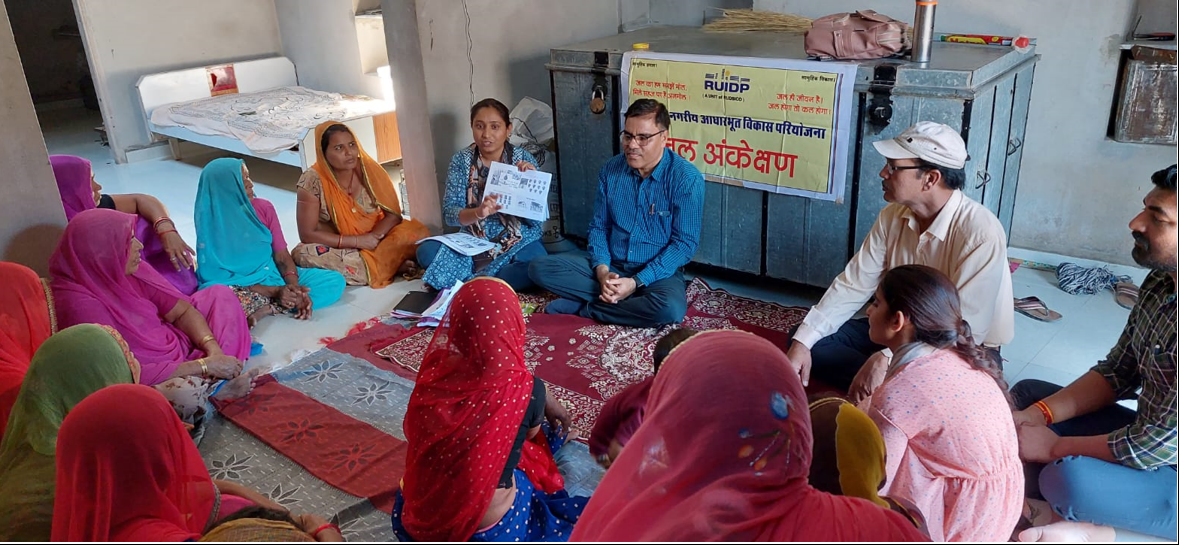
When Babita Jangid, a Community Motivator with Manzil — a project that enables access to skill courses for young girls in rural Rajasthan and helps them secure jobs — first began her work in the village of Mordha, at Kotputli, she initially only knew Anganwadi Karyakarta, Manju, from the village. Reflecting on her early days, she recalls, “Imagine entering a village in the interiors of rural Rajasthan and telling the community that I was there to support their daughters get skilled so that they can have jobs outside the villages and even in cities— many viewed me with suspicion, obviously suspecting my motives.” She continues, “Some even told me outright that I shouldn’t set foot in the village, as girls here don’t step out. It was only Manju who supported me through it all.”
Manju stood by her like a rock. And as a result, Manju was subjected to similar suspicions by the villagers. “Families in the village were alien to the idea of girls living independently and earning an income, and hence their suspicion was only natural,” recalls Manju. And yet, persistent and determined, the women patiently kept at their job. Their joint efforts gradually transformed the sceptical community into one that now embraces and welcomes the empowerment of young girls, including supporting them to pursue higher education, have a career outside the villages in distant cities and live life on their own terms. In four years, Babita has got over 200 girls from her block, trained in market-driven skill courses offered by Rajasthan Skills and Livelihood Development Corporation (RSLDC), all of whom are working, earning a minimum of Rs 10,000 a month, says Babita with pride. And nobody could be prouder than Manju Sharma. When Babita is interviewed about her achievements, Manju makes steaming cups of tea for everyone and tells the stories as her own. They are joint victories, for sure. “Yeh hamari best friend hai,” says Babita, about Manju Sharma, without whom she knows she could never achieve the results she did. As a result of more than two years of intense intervention, Babita and Manju say, “Initially, we used to visit door to door and convince parents to send their daughter who had dropped out of formal education for skill training courses. Now, I wake up to calls from parents with queries about skills and jobs for their daughters.”
So many of the successes of the Manzil project have been about friendships like that of Babita and Manju: of women collaborating with each other for the same cause, of two unknown warriors united over a common mission, of a sisterhood built over shared tears. Trying to reverse and resist generations of rigid social norms is not easy — and almost every step of the Manzil project in some way defies the convention. In communities where it is not common for girls to continue education after completing schooling, Manzil encourages girls for skill training, employment and continuing higher education. Where marriage and housework for girls are seen as the only choice, Manzil is enabling women to envision a life full of possibilities, including delaying the age of marriage and moving out and living independently. However, there is resistance within families and communities due to fear or concerns about security. And each of these tense situations has had on its other end two or more sets of women collaborating to convince, assuage fears, and lend a shoulder to cry on. Even fight.
Community Motivators and District Coordinators often go beyond the call of duty and watch out for the girls, like elder sisters. Rekha, a girl from Jaipur district who was placed in a skill training course by Manzil, recalls being hit by severe pangs of loneliness in the early days of her training, and her Community Motivator, whom she lovingly calls “Manzil Didi” promising to recruit girls with similar aspirations from her village into the same training course, just to make her feel at home. Sneha, the District Coordinator of Manzil at Dungarpur, has been overseeing the career of Monica, a girl with a locomotive disorder, and is now planning to open a boutique in Udaipur. One will find similar examples of support systems across all the project districts of Rajasthan. There are also solidarity networks between the mothers of girls now working in cities, who are proud of their daughters’ achievements and are actively vocal about the importance of girls’ economic independence. They are also motivating other parents to take a step in the right direction.
Then there are the friendships that form between two Manzil girls, often in training, or when they get placed, which end up like support systems. Many of the girls have fought with their families and left home, and this friendship becomes a source of strength for them. Deepa from Ajmer district, who joined a course on Cloud Computing under very difficult personal circumstances, started working in Jaipur city, which also employs fellow Manzil girl, Santosh. Living in a big city for a village girl like Deepa would be impossible without a friend like Santosh, her confidant, colleague, and roommate. The two of them split the room rent of Rs 3000, and other expenses and also share cooking and other duties on the home front. “We cook simple, inexpensive items like roti, dal, sabzi. We get food supplies — like wheat, mirchi, haldi — from home, through the village ration. The rest of the things, like vegetables, we buy from a weekly vegetable market,” says Deepa. Despite the demanding work schedule and compulsion to live on a budget, the two friends are a support system for each other. “I end up making a lot of gobi, because my roommate likes gobi, we also make mirchi tamatar,” smiles Deepa.
These friendships have offered them a new template for living life — different from what they were offered in the traditional home set-ups. Manisha from Dungarpur district, one of the nine siblings from an impoverished family, is unrecognisable in her denim jacket and kurta. However, it is her newfound confidence that stands out the most. She works hard during the week to save up for her studies and send money home. On her days off, she goes out with her huge group of friends, all of whom have been placed by the Manzil project in Jaipur city, visiting monuments like Hawa Mahal, Jal Mahal and other sights. “We are all brought up to believe that marriage is the only goal in life. But this life has made me realise that we can get education, skill training and earn and save for an education. Marriage is not the only goal for girls,” she says. There are numerous instances where girls who are now working are inspiring each other to pursue higher studies. Rashmi from Bhilwara, who is working in a hospital in Jaipur city, has inspired her sister and other colleagues to enrol for a Nursing course to ensure their career advancement. Most of these girls were compelled to drop out of formal education after Grade 12 due to financial barriers and familial pressures.
This unintended consequence of the project not only underscores its impact in empowering individual girls but also highlights its broader influence in ushering a culture of inclusive growth and empowerment within the communities.
Project Manzil is implemented by IPE Global as part of its initiative to empower young girls to reduce instances of early marriage and teenage pregnancies. Since 2019, the project has linked 28,000+ girls to skill training and placed 16,000+ girls in gainful employment.